
Agent control
The Agents view is an operations console for authority already granted through the local control plane. It is not a chat interface and does not create a new kind of autonomous agent.
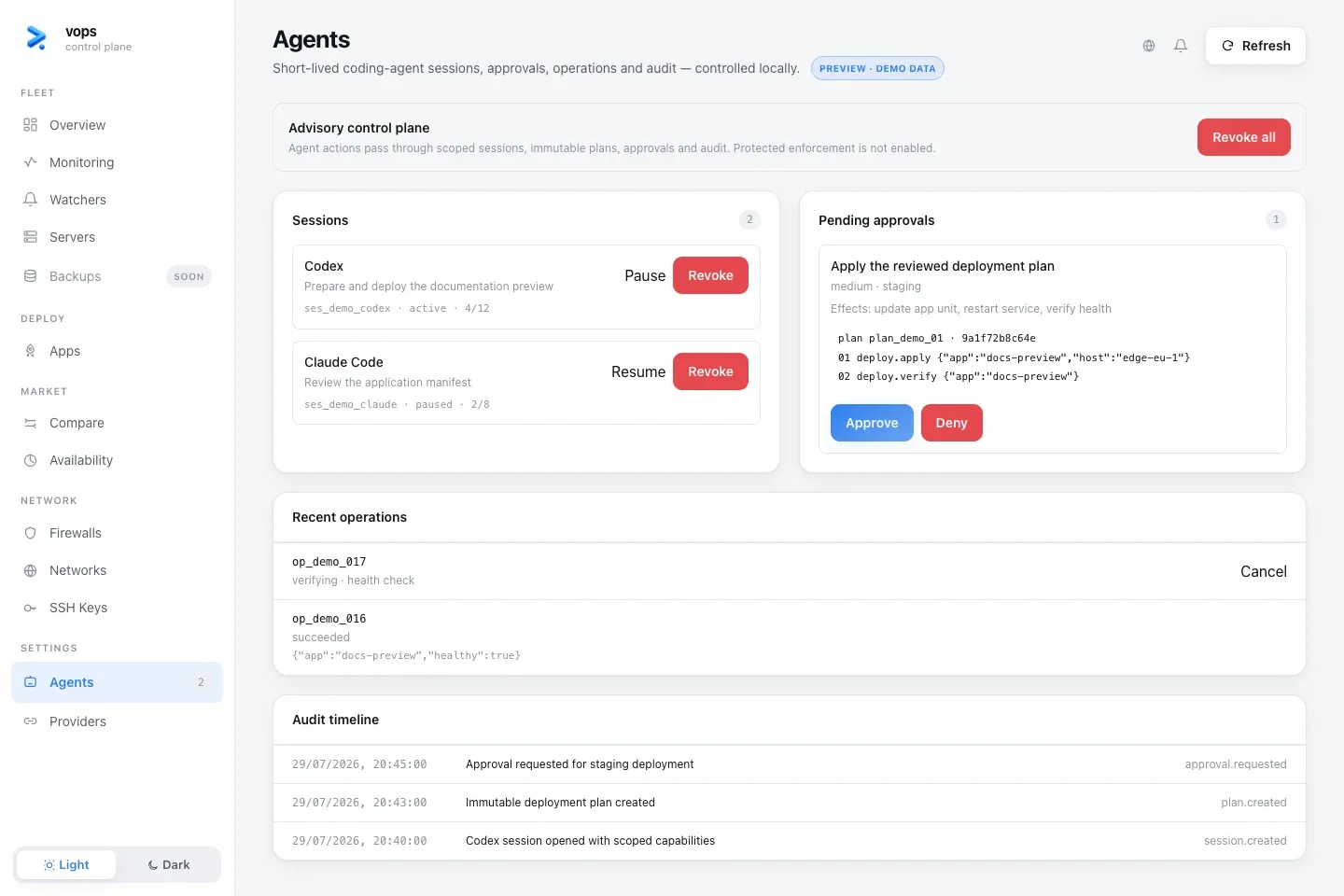
Mode banner
The page identifies the current mode as advisory. This is load-bearing language: sessions, plans and approvals govern calls through vops, but an agent running under the user’s unrestricted OS account may still have other paths to SSH or local files.
Protected enforcement must not appear enabled until an isolated launcher actually removes those bypass paths.
Sessions
The Sessions panel shows:
- client identity;
- objective;
- session status;
- current operation count and limit;
- pause, resume and revoke controls.
Session creation remains an explicit CLI workflow because the human should define objective, targets, environment, expiry and budget deliberately.
Pending approvals
Each pending request shows:
- reason and risk;
- environment;
- expected effects;
- immutable plan ID and hash;
- semantic plan steps and inputs;
- approve and deny controls.
The human should be able to evaluate the effect without reading an internal SSH transcript. Changing the plan after approval invalidates that decision.
Recent operations
Operations show state, current step, structured error and a compact result. A cancel button requests cancellation for queued, running or verifying work.
Cancellation is not rollback. The final state must say which effects had already completed.
Audit timeline
The timeline shows local events in chronological order. It should make session creation, policy decisions, approvals, execution, denial, revocation and errors distinguishable without exposing secret inputs.
Revoke all
Revoke all is the emergency control for every active or paused agent session. It must remain visually separate from routine per-session controls.
Revocation cuts off vops-mediated authority. In advisory mode it does not stop a separate unrestricted shell process, which is why the mode banner and agent approaches remain essential.